
This blog post is a summary of three topics of the ONL181 course. Topic 3-5, networked collaborative learning, the design of online and blended learning and, lessons learned and future practice.
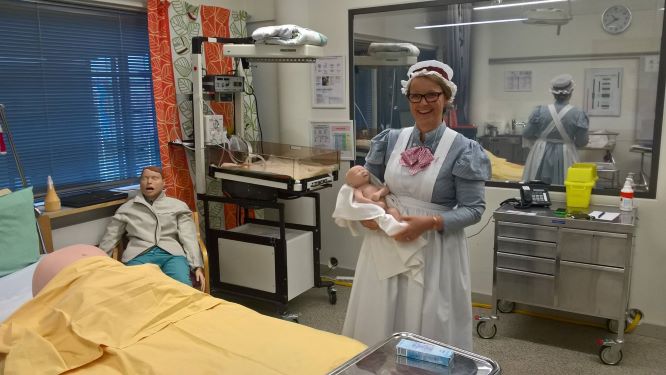
The midwifery profession is as known a profession where the connection with and to the patient/client is the basic core for a good experience of care for the patient as well as for the caregiver. Midwifery education with its long history of apprenticeship has also a basic core in collaborative learning between the master and student. I was fascinated by the emotions role in online teaching and learning by Bart Rienties and Bethany Alden Rivers (2014) and immediately saw the relation to the midwifery education. Midwives work with people in highly emotional situations and need to be extremely tens on reading the patients emotions as well as deal with their own emotions in critical stressed situations. the article by Stenbom, Hrastinski, and Cleveland-Innes (2016) clarified the emotions essence as a distinct part of learning. This connected me to the emotional bond between the master and the student during clinical practice in midwifery setting and how it is essential for a good learning experience which outcome will hopefully give a good emotional bond to the patient too.
I have without thinking of it put a big effort in my teaching on my student´s emotions, how they are feeling in the class as well as out in the clinical setting. Now I got confirmed I am on the right track. My challenge will be how to implement the emotional part in online teaching when the contact with the students does not physically be face to face. On the other hand, I feel I got permission from this course to put as much or even more effort on the emotional part. As a crucial part of learning especially online is emotional as the article by Cleveland-Innes and Campbell (2012) gave me. I also got confirmed I do not have to get everything online, some emotions can be good to have face to face.
To be able to change my teaching habits from face to face teaching towards online I have to shake the whole course in a new shape. The ONL PBL2 group presentation of Topic 3, ONL PBL2 where we did a mindmap over strategies for creating effective collaborative learning and a SWOT analysis will be helpful in the course design. Gilly Salmon´s Five-Stage Model is useful especially when you got, as a student the experience of a course that had used it in the framework creation. I wish I had it earlier this semester when I tried to do a topic of a course I am in charge of online and failed totally. The students did not show up on a chat in the course. I cannot blame them because the structure of the course was not clear and progressive as it should be, and I have a feeling that my instructions for the chat were unclear. Next time I will hopefully have more success when I got all these models and materials for creating online courses.
When I attended the course ONL the intentions of my own learning was to see if there is something I could use in my teaching. I thought that midwifery is such a traditional profession where the focus is very much on hands-on skills and to cope with emotions and strategies of coaching, supporting and the online method is partly useful for it. After this course, the profession is still what it has always been but I have realized that you do not have to be face to face to teach all those skills. Some skills might be even better to do online especially when more and more parts of the midwifery work are interaction online.
This puzzle of Universal design as a pedagogical strategy by UDLL an Erasmus-plus project is visually clear and useful when designing an online course, thank´s to our supportive facilitator on the ONL181 course for sharing it with us at the end of the course. I will certainly use it when designing my next online course.

 This work is licensed under a Creative Commons Attribution-NonCommercial 4.0 International License
The learning experience of the ONL course has been interesting and fulfilled with work. I have to say that I didn´t know how much work it was to finish the ONL181, and I am glad not knowing. The dropout rate on online courses is high, one experience we had in our PBL group and a reality to remember in the future. On the other hand, I have to thank my Finnish sisu not to drop out during the journey even if it was really close. That experience helps me in coaching and supporting students in online courses I will facilitate in the future.
Thank´s to ONL 181, PBL2 and my colleges at UAS
-Pernilla-
References:
Stenbom, S. Hrastinski, S. Cleveland-Innes, M. 2016. Emotional Presence in a Relationship of Inquiry: The Case of One-to-One Online Math Coaching in Online Learning – Volume 20 Issue 1 – March 2016. https://files.eric.ed.gov/fulltext/EJ1096376.pdf
Cleveland-Innes, M. Campbell, P. 2012 Emotional Presence, Learning, and the Online Learning Environment, The International review of research in open and distributed learning (IRR ODL) Vol 13, No 4 (2012). file:///C:/Users/stenbape/Downloads/1234-10784-2-PB.pdf
Rienties, B. Alden Rivers, B. 2014 The Learning Analytics Review, published by the LACE project at the University of Bolton, Bolton, UK. ISSN:2057-7494. Licenced: Bart Rienties and Bethany Alden Rivers, for the LACE Project (http://www.laceproject.eu)






 LecturerMidwife